


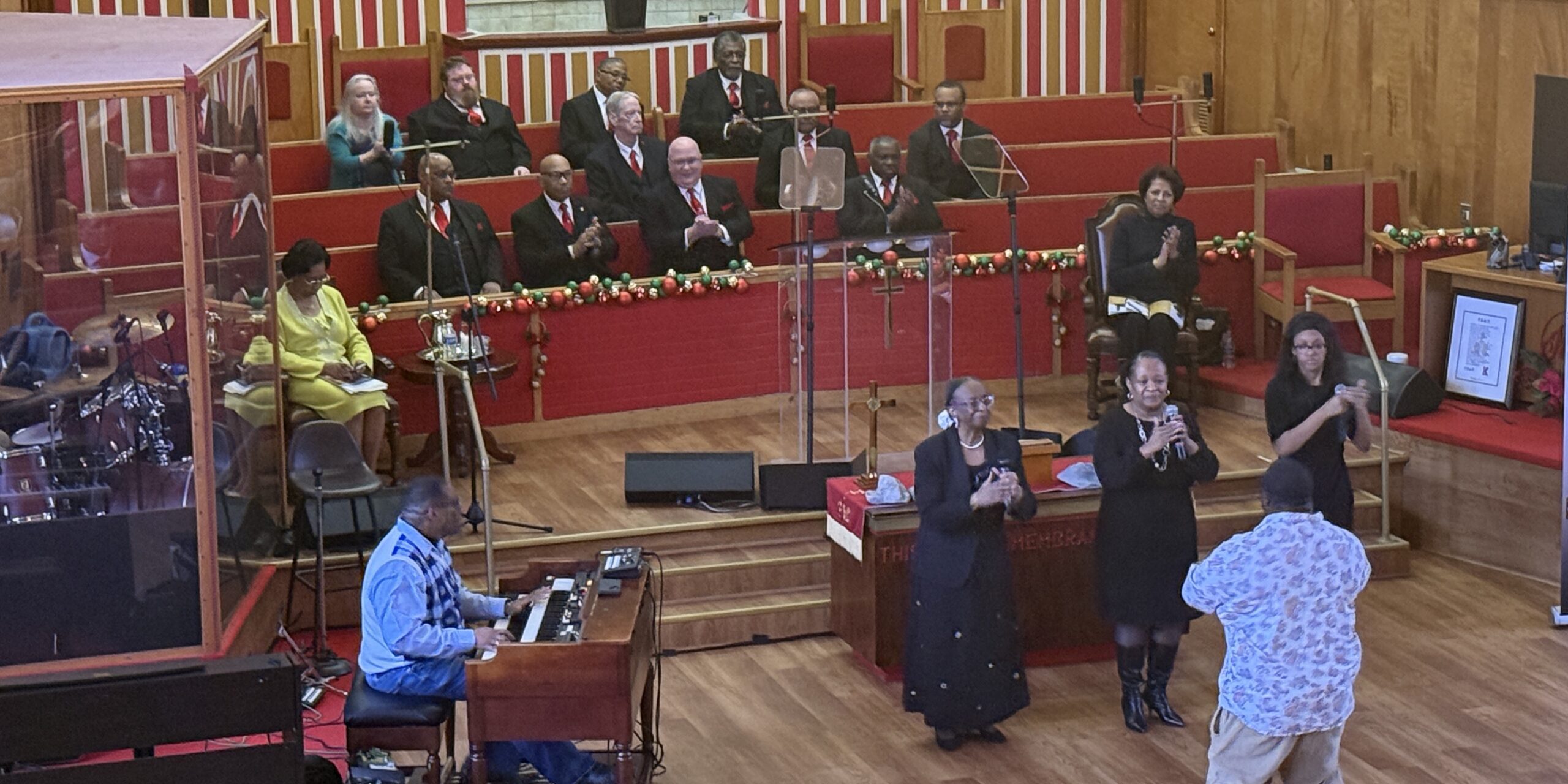
CHARLESTON, W.Va. – Nearly 62 years ago, the Reverend Dr. Martin Luther King, Jr. stood before the congregation of Charleston’s First Baptist Church and West Virginians gathered in the same sanctuary to honor his life on the holiday bearing his name.

Ericke Cage
The West Virginia Martin Luther King, Jr. State Holiday Commission presented its annual ecumenical service on Monday, with speakers describing the impact that King still has today.
“His words continue to ring very clearly, and over the ages, they’ve stood the test of time. Again, they remind us to continue to strive for equity, to continue to strive for understanding, to continue to strive for equity, to continue to strive for understanding, for hope, and for community,” West Virginia State University President Ericke S. Cage said.
Cage delivered the service’s keynote address and used some of King’s own words to remind those in attendance of what effect he still has today. Rep. Carol Miller echoed Cage’s sentiments in her remarks.
“His teachings remain to this day to be a cornerstone of wisdom for all of the generations, reaching far beyond the time period that even we live in,” she said.
In recognizing King’s contributions, focus also centered on how his mission can be carried forward, even in 2026. Cage believes King showed Americans what they are capable of doing for one another.
“The Reverend Dr. Martin Luther King was a very important leader, not just in the civil rights movement but also as a moral leader, someone who reminded America of what is possible, possible with respect to ensuring that all of our citizens are treated fairly,” he said.

Jill Upson
Jill Upson, the holiday commission’s chair and the executive director of the state’s Herbert Henderson Office of Minority Affairs, looks at Martin Luther King, Jr. Day as an opportunity to put his teaching into action. She called on those in attendance to do more than just listen to the words during the service.
“With this occasion, we are challenged to move beyond the simple recognition of the dream to the active work of living out the dream,” she said.
Miller (WV-1) described her experience growing up in the 1960s as King spearheaded the Civil Rights Movement and her feelings as a high school senior when he was assassinated in 1968. She said what he stood for remains an example of how to live.
Carol Miller
“Dr. King embodied gentleness without weakness, pairing compassion with resolve that was necessary to move our nation forward, and this is a lesson that I think we can all carry with us today as we live our own lives,” she said.
Cage took it as a point of pride to be the keynote speaker before the crowd assembled inside the church. In his eyes, days like these are proof that West Virginia cares about its people.
“It’s committed to making sure that we’re taking care of one another, that we are lifting up our neighbors, that we are creating a state that all of us again can rise,” he said.
During the service, the Martin Luther King, Jr. Holiday Commission also recognized the 2026 recipients of its “MLK Jr. Living the Dream” awards in the categories of Advocate for Peace, Sharing of Self, and Human and Civil Rights, as well as the Governor’s Living the Dream Award and the Service Organization Honor Roll.
Governor Patrick Morrisey proclaimed Monday to be the Martin Luther King, Jr. Day of Service in West Virginia and encouraged West Virginians to honor King’s legacy through community service, engagement, and remembrance.
Additional events recognizing King’s legacy included a celebration at the Martin Luther King, Jr. Community Center, hosted by the Charleston-Institute chapter of The Links, Incorporated, and ceremonies around the state in towns like Lewisburg and Clarksburg, as well as on college campuses at West Virginia Wesleyan and Davis & Elkins.